
At the beginning of November, a Change Lab workshop was organized to continue with the activities of the Italian local network, in order to put the basis for a shared meaning about the key-concepts and fundamental themes of the project, and carrying forward the reflections and considerations on possible actions to be initiated within one's own context.
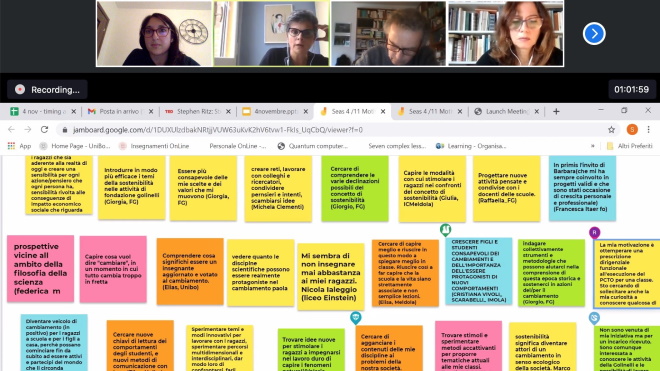
Due to the pandemic situation, it was chosen to propose the activities in an online and interactive workshop format, during which small groups made up of teachers, researchers and educators discussed the terms, practices and experiences that are commonly associated with the concepts proposed through short video stimuli, and then sharing in plenary the results of group activities through the production of digital artefacts.
During the first day of the workshop, different stimuli were chosen to trigger discussion and reflection about concepts and features of open schooling, scientific literacy and sustainability in its multiple forms and meanings.
The school as a vital centre of innovation
A video showing the work of a teacher, Stephen Ritz, in the tough neighbourhood of South Bronx, where an originally after-school program for high school students evolved into a successful indoor gardening curriculum helping them not only to eat better but also to be more engaged with school, thus building their pathways for jobs and promoting a transformative action on the community, promoted the discussion among the participants about the concept of open-schooling and the possible related actions.
Some of the needs emerged in order to implement an efficient action of open schooling were the possibility of putting the students in contact with local stakeholders.
Thus ‘bringing out’ the kids and proposing the school as a vital centre of innovation and culture, going further the preconceptions about the classic role of the school and thus promoting that process of engagement between community and students who became agents of change with repercussions on the community and territory.
At the same time, some of the possible ‘difficulties’ that it may encounter in that process have been highlighted, such as the need for building a flexible and transversal school and overcome the obstacles related to the work relationships with local stakeholders.
Science of complexity
Then, an insightful presentation carried out by Eleonora Barelli about the connections between scientific literacy and the science of complexity, showing the different types of scientific literacy (practical, civic, and cultural) and focusing on its civic aspect and links with the philosophy of the project, has been the starting point for introducing the discussion on the issues of action/engagement towards sustainability themes and the need for linking these issues with scientific literacy.
On one side, science of complexity allow us to recognize the agents and their importance to produce collective phenomena, on the other side it is important to recognize the system properties able to influence those same agents thus altering their individual behaviours; nevertheless agents have the transformative power with their actions to change the system, modifying its rules and generating a new collective level.
This was a powerful starting point pushing participants to reflect about the interactions between individual and collectivity, stressing that individual choices may have an effect on the collectivity only if supported by knowledge, the knowledge to act and taking decisions which makes citizens confident and independent in their actions and critical choices.
Sustainability in its multiple forms
A final input for this part of the workshop was the definition of sustainability and the important questions related to that, focusing on the possibility to build a framework for teachers for developing sustainability literacy through cross-cutting themes such as different ways of thinking: futures thinking, systems thinking, values thinking, and strategic thinking.
This proved to be an important moment among participants to reflect on how to introduce sustainability issues at school among students and which school practices could be most effective.
It emerged that a good practice would be to identify the real value of sustainability showing that today actions have consequences on tomorrow, building a concrete bridge between past and future.
A look to the future
The idea and need for a look to the future has been underlined several times, referring it on practical aspects of daily life, such as energy resources, the protection of cultural and environmental heritage, and the fight against waste.
The first day ended with a simple task given to the participants, which was to think and list their possible challenges in disciplinary and extracurricular teaching, and also in their relationships with the school, with colleagues and in their private sphere. Thus, the second day opened with the sharing of these challenges collected on a digital whiteboard.
The sharing of these work and personal challenges was another important moment of reflection, where several questions emerged: from how to be able to involve students in activities in which they themselves find results and draw conclusions, or how they could insert into classic lessons the major social, environmental and cultural issues, how to be able to open the school to the world with experiences that are not only suggestions but also leave a tangible mark in one's heart and mind, and how to be able to offer students spaces of planning and active participation, giving the school the possibility to create community.
The day then continued with the introduction of the tools designated from several partners within the project and local network (cCHALLENGE, Climate Simulator, Change Game) with the specific aim of responding to various objectives, such as supporting the development of a scientific literacy within educational activities already started, facilitating the management of school work by supporting open schooling initiatives and helping in the expansion of collaboration between partners inside and outside the school.
Examples were presented of how these tools were used in the first year, and the reactions they aroused in the various participants in the activities carried out.
As conclusion of the workshop, a shared moment for planning the next phases was organized, entering into the specifics of how to develop the project and its objectives within the respective schools, considering the skills and experiences of the various partners, the already existing projects which may be included and the possibilities of new collaborations and involvement of new stakeholders.