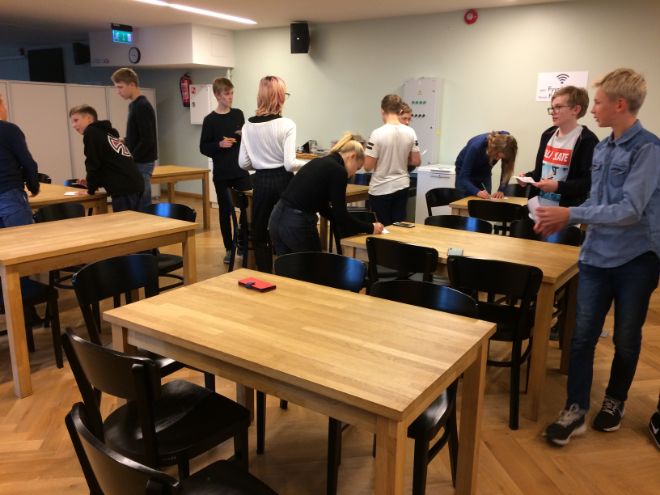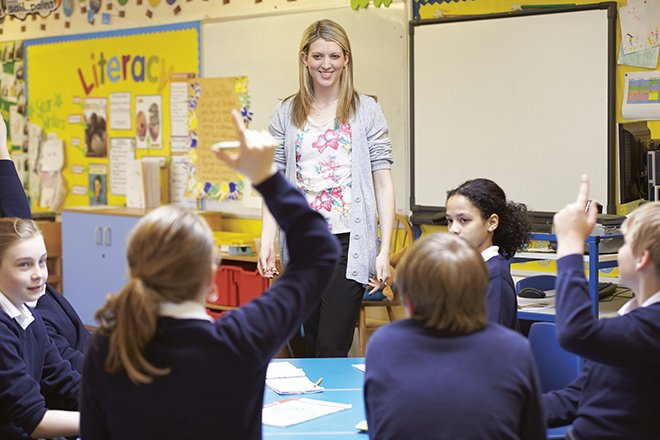
The Energy Discovery Centre has co-designed a curriculum with the stakeholders and is piloting an educational Science Club for secondary school students (with the average age of 13.4 years at the beginning of the club meetings, with students from grades 7 and 8), with the focus on sustainability issues and challenges in Tallinn. The students take part in educational activities at the Centre every week throughout the school year of 2020/2021.
Using the "word cloud"
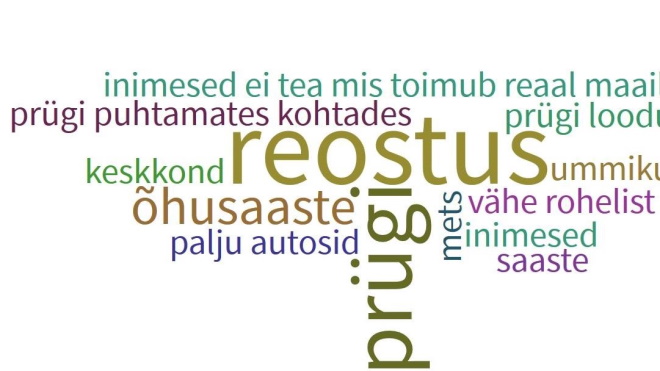
During the first meetings, the environmental problems that were most important for students, were mapped using the “word cloud” method.The idea behind was to map the situation at the beginning of the Science Club and then compare them to the answers the students will give eight months later. This aims to find out whether the Science Club has been successful in terms of broadening students’ understanding of local environmental problems and scientific literacy.
We asked the students: “What are the most relevant environmental problems in Tallinn for you?” The main issues the students mentioned were the waste (prügi) and pollution (reostus), the largest in the word cloud. Other issues were closely related to pollution as students mentioned the air pollution, cars and traffic jams.Students recognize the waste issue as an important problem also, as it was mentioned regarding littering in public places and nature. Forest/forestry and lack of green areas were mentioned a few times.
Comparing the results
Every other year the Estonian Ministry of the Environment surveys environmental awareness.The results of the 2020 survey were announced recently. In the survey, also, “The most important environmental topics in Estonia” were tackled and the top five most important environmental topics respondents brought out were the following: forestry/meadows management, extensive forestry; pollution, protection and management of water bodies; waste management, recycling and sorting waste; nature protection, pollution.
When comparing the survey and the answers from the students, pollution and waste are mentioned in both. The only topics students did not emphasize as important environmental problems were water-related issues although Tallinn is situated by the seaside and there have been campaigns related to marine litter lately. In general, the Science Class students and respondents to the survey see the same issues as probable threats to our environment. Currently a long-term strategy “Estonia 2035” is under development, where among five important objectives is our environment.
According to the document, the main environmental problems Estonia needs to continue to improve and develop are biodiversity, state of the environment of the Baltic Sea and greenhouse gases together with waste management.
The most important topics that the students reported can be compared to the Estonian national curriculum to see how the student’s knowledge accords to it. In the lower-secondary school level, which in Estonia means grades 5 to 6 where the students are aged 11-13 years, many environmental topics are covered.
The covered topics are the following:
- biodiversity in different habitats, (aquatic conditions, forests, fields, soil)
- pollution and human activity in these habitats,
- pollution in the air and its avoidance,
- biodiversity, pollution and protection of the Baltic Sea,
- Estonian natural resources and the connected environmental issues
- connection between humanity and the environment.
The latter covers a wide spectrum from biodiversity and environmental protection to waste management and sustainability issues. The comparison shows, again, that the water-related issues, as well as biodiversity, should have been covered more thoroughly in student’s answers.
Further development of the Science Club
To sum up, the students participating in the Science Club understand the environmental problems we face today and their knowledge is comparable with the respondents’ of the survey by the ministry, and to some extent also with the long-term strategy “Estonia 2035” which is currently under development.
In general, students are familiar with the topics that they need to master according to the National Curriculum, but their knowledge lacks depth.
Although we can only speculate why this knowledge is lacking, we can use this information for further development of the Science Club’s curriculum. For the next eight months, the main goal is to broaden the participating students’ scientific literacy and give them a deeper knowledge of the environmental problems we face locally here in Tallinn.